Bus Broker or Use the Bus Company?
Use a Bus Broker or Use the Bus Company – that is the question!!

Up until November 2015, Premier didn't own a single motorcoach. Eric Devlin, who founded Premier in 1996, told Chauffeur Driven Magazine in March 2017 that we were brokering between $600,000 to $800,000 a year in coach work to other bus companies in the DFW metroplex. When I write about brokers, I'm describing a model we once ran ourselves.
At a glance: A charter bus broker sells a trip and makes a markup when it farms the trip to a local bus company who actually owns motor coaches and services the reservation. The local bus company owns the motor coach, employs the driver, and holds the federal DOT operating authority. As the CEO of Premier Transportation in Dallas, I recommend booking a local operator for any transportation need, because the operator controls both the bus and the chauffeur. Secondly, bus brokers often find the least expensive option (bus company) which sometimes results in a less than favorable experience. Federal rule 49 CFR 371.7 requires brokers to show their broker status in advertising. Premier's published coach rate is $225.75 an hour with a six-hour minimum (October 2026).
What is the difference between a bus broker and an operator?
The difference is simple: an operator owns the motorcoach and employs the chauffeur, and a broker hands your trip to an operator you may never speak to or know of until the vehicle shows up.
The Federal Motor Carrier Safety Administration (FMCSA), the agency that regulates interstate bus companies, treats the carrier that drives you separately from the broker that arranges the trip. Every interstate passenger carrier needs a USDOT number, the federal ID that ties a company to its safety record.
Plenty of Dallas "charter bus" pages come from bus booking networks. One national booking site's terms, checked October 22, 2026, say the service is provided by "an independent third-party company."
Do brokers have to tell you they are brokers?
Yes, a bus broker registered with FMCSA has to say so in its advertising, under 49 CFR 371.7. The rule, current as of October 26, 2026, reads: "A broker shall not, directly or indirectly, represent its operations to be that of a carrier. Any advertising shall show the broker status of the operation."
In practice the disclosure is often small. Look for "network," "partners," "vetted providers" or "independent third party" on the site and in the terms. Those words mean the company selling the trip won't be the one running it.
Why does it matter who owns the bus?
The company that owns the bus controls what happens on the day of your trip, and a broker controls the sale. I wrote in April 2026 that brokers "lose control of quality the moment you sign the contract." I still think that's the clearest way to put it.
We confirm every trip 24 hours out and again 60 minutes before pickup, and our dispatch department tracks every chauffeur by GPS around the clock.
With a broker in the middle, a changed pickup time goes from you to the broker, then to the operator, then to the driver. Three handoffs – ample opportunity for errors.
Accountability follows ownership too. The operator's USDOT number is the one on the federal record, and you can check that company's safety rating before you pay.
Is a broker quote cheaper than booking direct?
A broker quote often looks cheaper at first, and in my experience the gap usually closes once the fees are counted. Fuel surcharges, gratuity, tolls and after hours fees can add 30% or more to a quoted price.
Deadhead is the line to watch. Deadhead means the miles or hours a bus drives empty to reach your pickup or get back to its garage. A broker that books a coach parked across the Metroplex, or in another city, may pass those empty hours on to you.
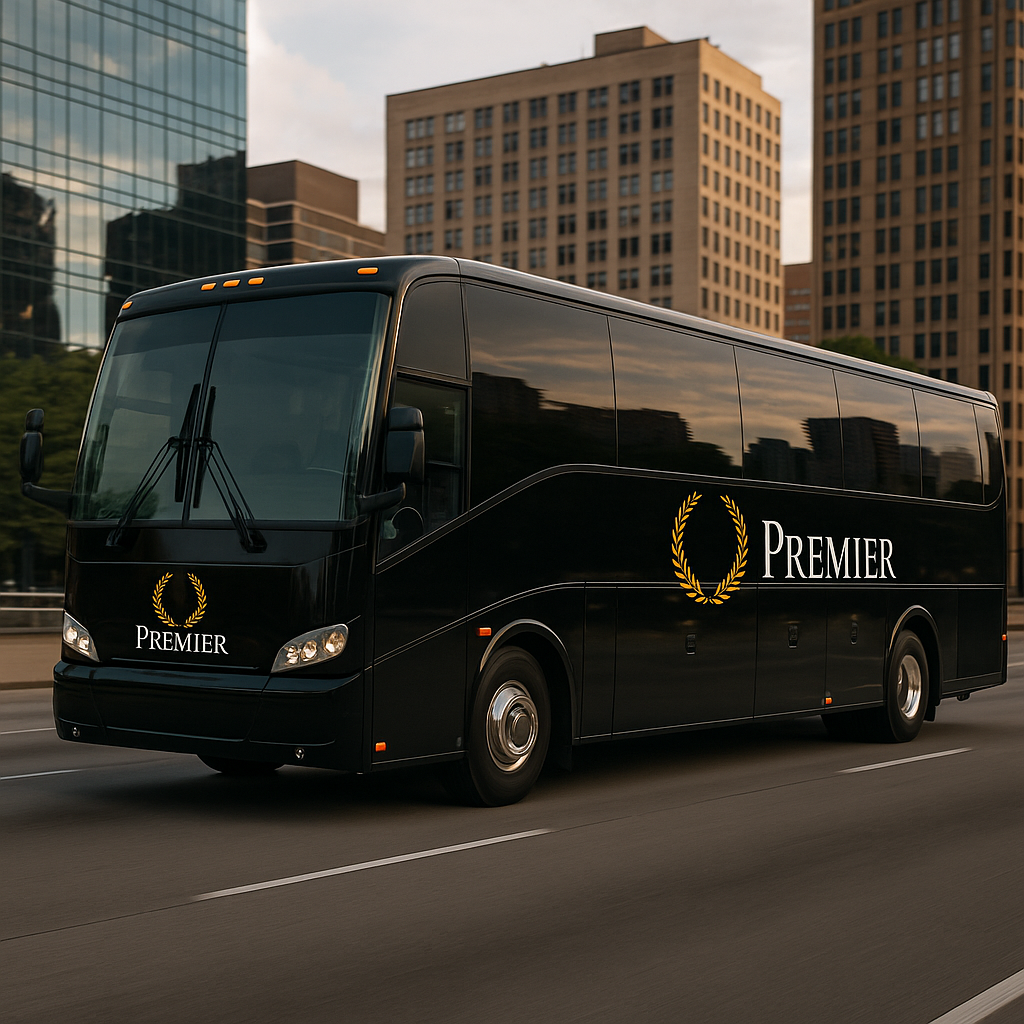
At Premier, a 56-passenger coach is $225.75 an hour with a six-hour minimum (as of October 2026), which totals $1354.50. Currently, this rate includes all fees (fuel surcharge) and the chauffeur’s pay. Gratuity is optional and left up to the discretion of the client. We suggest a 5% or 10% gratuity.
How do I tell if a Dallas bus company is a broker?
Ask these five questions, then check the answers against the federal record.
1. What is your USDOT number? FMCSA's Look Before You Book guide (checked October 27, 2026) says to search the SAFER database by number, because many company names look alike.
2. Whose name is painted on the coach that will show up?
3. Is the chauffeur your employee?
4. Where is the coach garaged, and do you charge for deadhead( sometimes called garage-to- garage)?
5. Who answers the phone at 2 a.m. on the day of my trip?
If a company can't, or won't, answer the first two, that's your answer.
When does a broker make more sense?
A broker makes sense when your trip starts in a city where you are unaware of a local operator, or when one booking has to cover several cities. We do a version of this ourselves. Trips that pick up or drop off in Dallas or the surrounding area run on our own coaches. Anywhere else, we can use coaches from our sister companies in the Hoffmann Family of Companies, which run coaches across the US, or book a partner operator through Premier's affiliate network (other bus companies we work with on a reciprocal basis).
Brokers also argue they have more choice and more capacity on peak days. It's a fair argument. On a Saturday with a home game and a convention, any single operator can run out of buses, and a broker with hundreds of partners has more places to look. But remember, control, safety and communication is key to a successful event. Planning – months in advance – alleviates many of the problems that occur when using a broker.
What does Premier's federal safety record show?
Premier Transportation operates under USDOT 2070765, and FMCSA's SAFER system, as of October 27, 2026, shows a Satisfactory rating from an August 8, 2023 compliance review. Satisfactory is the highest of FMCSA's three ratings.
The same snapshot shows 0 “out of service” results across 15 vehicle and 6 driver inspections in 24 months. It shows 0 fatal and 0 injury crashes and only 3 tow away incidents over those 24 months.
Frequently asked questions
Is a charter bus broker legal?
Yes. Bus brokers are legal and regulated by FMCSA, and 49 CFR 371.7 requires them to show their broker status in any advertising.
Does Premier Transportation broker trips?
Premier Transportation runs its own coaches and chauffeurs when a trip picks up or drops off in Dallas or the surrounding area. Anywhere else, Premier may use coaches from its sister companies in the Hoffmann Family of Companies, which run coaches across the US, or book a partner operator through Premier's affiliate network.
How do I find a bus company's USDOT number?
Ask the company for it, then search the number on FMCSA's SAFER website. FMCSA recommends searching by number because many company names look alike.
Are broker quotes all inclusive?
Not always. Ask whether the quote includes gratuity, fuel, tolls, deadhead and after hours charges, and get the total in writing before you commit.
Published November 4, 2026. Prices and federal data as of October 2026.
Kelly Devlin is CEO of Premier Transportation in Dallas and has worked in chauffeured ground transportation since 2000, starting out at Xtreme Limousine in Tucson. She was named a 2025 Dallas Business Journal Women in Business honoree, and Premier runs its own motorcoach fleet under USDOT 2070765 with a Satisfactory federal safety rating (FMCSA review dated August 8, 2023).
Share